Thursday, 16 August 2018

Whinchats at Caldecote

Wednesday 15th August 2018

Another local site which regularly turns up migrants is along the river Anker at Caldecote. Whinchat and later Wheatear use to the dead Dock stems as look-out posts along the river. Today there were a pair of Whinchat along with good numbers of House Martin.


Whinchat, Caldecote

Monday, 13 August 2018

Starting to start

13th August 2018

The first signs of return migration : Swifts disappearing, Wood Sandpipers and other waders appearing at local lakes and the first few Redstarts and Whinchats turning up at traditional local hotspots. Regular visits to these sites usually pays dividends through the coming months. One such 'spot' I've been visiting for a few years, the Mancetter hills near Atherstone has a good record as a migrant stop-over. Yesterday  migrants heading south included 3 Redstarts and a Whinchat. Today there were still 2 Redstarts on 'the hill' but no sign of the Whinchat.


Redstart, Mancetter

Redstart

Whinchat

Wednesday, 8 August 2018

Menorca, August 2018

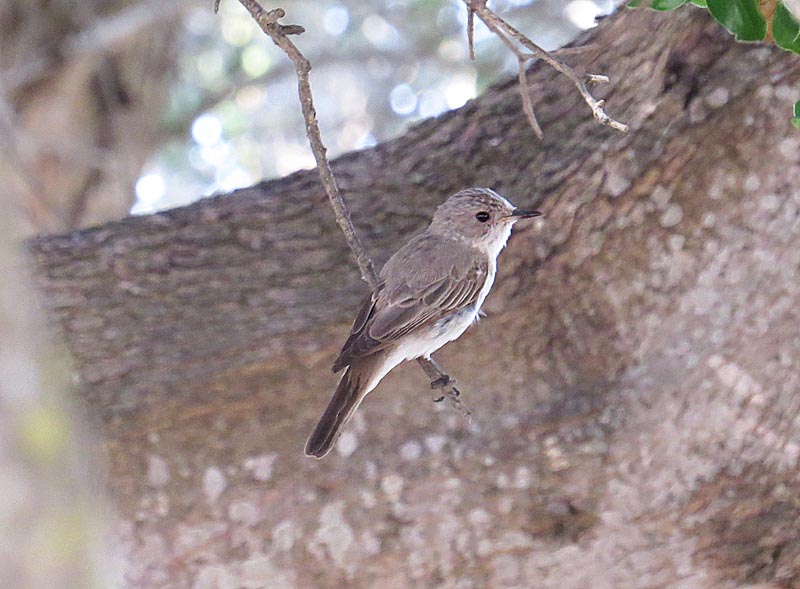
My wife, Jan's birthday was the excuse for a family holiday in Menorca, Spain. Our holiday coincided with a heatwave throughout Iberia. With temperatures of 36 + even the 1/2 mile walk to the beach was an effort. The 30 yard walk to the pool was more realistic and with the opportunity of playing with my Grandchildren that was the preferred option most of the time, it was also great fun, for a short time anyway. So little opportunity for serious Birding but various birds were seen. A pair of Egyptian Vultures, a Booted Eagle, Red Kite were seen over the rocky outcrops  overlooking the hotel and several Audouins Gulls were seen patrolling the beach. It was also good to see Turtle doves and Spotted Flycatchers in good numbers, two birds now rarely seen in North Warwickshire.

Audouin's Gulls

Audouin's Gull

Mediterranean Spotted Flycatcher

Turtle Dove

Monday, 16 July 2018

Still very quiet

Saturday 14th July 2018

Lethergy rules. I'm not coping with the continuing high temperatures very well to be honest. Horse flies, stinging nettles etc. have put me off some of my regular walks. A Great spotted Woodpecker was a welcome visitor to the garden and Swift numbers (max. 12) have increased in recent days. A notable lack of small birds though, probably due to Magpies, Jackdaws and Grey Squirrels.
           But then, through the gloom, Brandon Marsh, as it has many times in the past, comes up with some welcome relief in the form of a Pectoral Sandpiper. A welcome Trans-Atlantic visitor.

Pectoral Sandpiper, Brandon Marsh


Monday, 2 July 2018

Night of the Owls

Saturday 30th June 2018

Extraordinary events this evening. Ok the World Cup produced a couple of good games but it was after that as the orange glow faded from the sky, that the real excitement started. I'm very fortunate in being surrounded by bungalows allowing  uninterrupted views to the north from my bedroom.
    Last night I was lucky enough to watch  a couple of Bats briefly fly around a large Ash tree in a neigbouring garden, first bats I'd seen this year. As I waited for them to reappear a Tawny Owl flew low across the garden, a garden first. OK, as if that wasnt enough excitement it seemed to flush a Little Owl from another large Ash in an adjacent garden. I wasn't dreaming and I hadn't been drinking well, only a couple anyway. You don't see an Owl of any description for a year and then 2 turn up in your garden.

Thursday, 28 June 2018

The Dolomites - Northern Italy

Sunday 24th June 2018

Hardly time to unpack before jetting off again on a very different trip. No birding involved this time although I thought it would be rude not to take my bins. Malcesine was the base for this  Italian adventure with Jan my trusty companion and tour organiser and wife. Nice Hotel with views of Lake Garda from our room's balcony. Even with non birding status for the week it was impossible not to notice the Black Kites on their leisurely patrols round the Lake. It was also impossible not to notice the family groups of Red crested Pochards around the lake as we took our daily walk into the centre of Malcesine. We did some usual touristy things: cafes, castles and Churches but also did a bit of walking above the tree line after an enjoyable Cable car ride to the summit of Mount Baldo. Apart from amazing views in the perfect conditions there was para gliding to watch, coffee to drink and away from the madding crowd there were Marmots to watch and a few Alpine birds: Ring Ouzels, Tree pipits, Black Redstarts, Alpine Chough, Alpine Swift and Fieldfare with Crag Martins at lower levels.
The Dolomites - Northern Italy

Monday, 11 June 2018

Kazakhstan - June 2018

Monday 11th June 2018

After a relatively quiet spell of local birding. I was lucky to have the opportunty to find some more unusual species, including a new bird for me, on an adventure organised by Birdfinders to Northwest Kazakhstan on the very edge of the Western Paleartic.
The group led by Vaughan and Svetlana Ashby travelled to Atyrau in Kazakhstan via Moscow. We visited a number of sites around Atyrau some involving water courses and the Ural river itself and some involving tortuous treks into the Steppes, vast areas of flat dry grassland.Subtle changes in this habitat produced the 'special' birds we were after :Larks, Plovers and Cranes in particular places. Our 4 x 4 were tested on tracks through the Steppe terrain. On one occasion a loud bang was heard as we hit another hole causing a wheel to fall off. The wheel nuts were located back up the road and the driver did a great job in getting us going again.
Raptors were seen regularly in the skies with White tailed and Steppe Eagle the most impressive but  Black Kite, Marsh, Pallid, Montagu's Harriers and Long legged Buzzard were also seen. For me though the star birds of day 1 were Caspian Plover and Demoiselle Crane.
The Steppes also provide  a Habitat for Larks including White winged Lark a species not found elsewhere in the Western Paleartic. Other Larks included : Calandra Lark, Short toed and Lesser short toed Larks, Skylark and Black Larks.

Demoiselle  Crane

Distant Caspian plover

Black Lark

Calandra Lark

Calandra Lark

White winged Lark

Warblers were few and far between although several Sykes warblers were noted and Eastern  Olivaceous and Booted warblers were also seen. Isabelline Wheatear were by far the most common Wheatear of the Steppe with Pied Wheatear often seen around farms and towns. Red headed Buntings and Shrikes favoured areas with a few trees and bushes.
Small colonies of Red footed Falcons were seen at various sites, while along the river and on larger lakes Caspian and Pallas's Gulls were frequent with groups of Terns moving through: Black, White winged Black and Whiskered.

Pallas's Gull

Red headed Bunting

Another bird of the muddy river edges were Black bellied Sandgrouse coming in in small numbers to drink and soak their feathers.

Black bellied Sandgrouse
Lesser grey Shrikes were the most abundant Shrike species greatly outnumbering Red backed Shrikes

Lesser grey Shrike

Hoopoe with Lesser grey Shrike
This is by no means a comprehensive account but gives a flavour of the birds of the area
Altogether a most memorable tour, and my thanks go to the organisers and to my colleages for making it so enjoyable.